
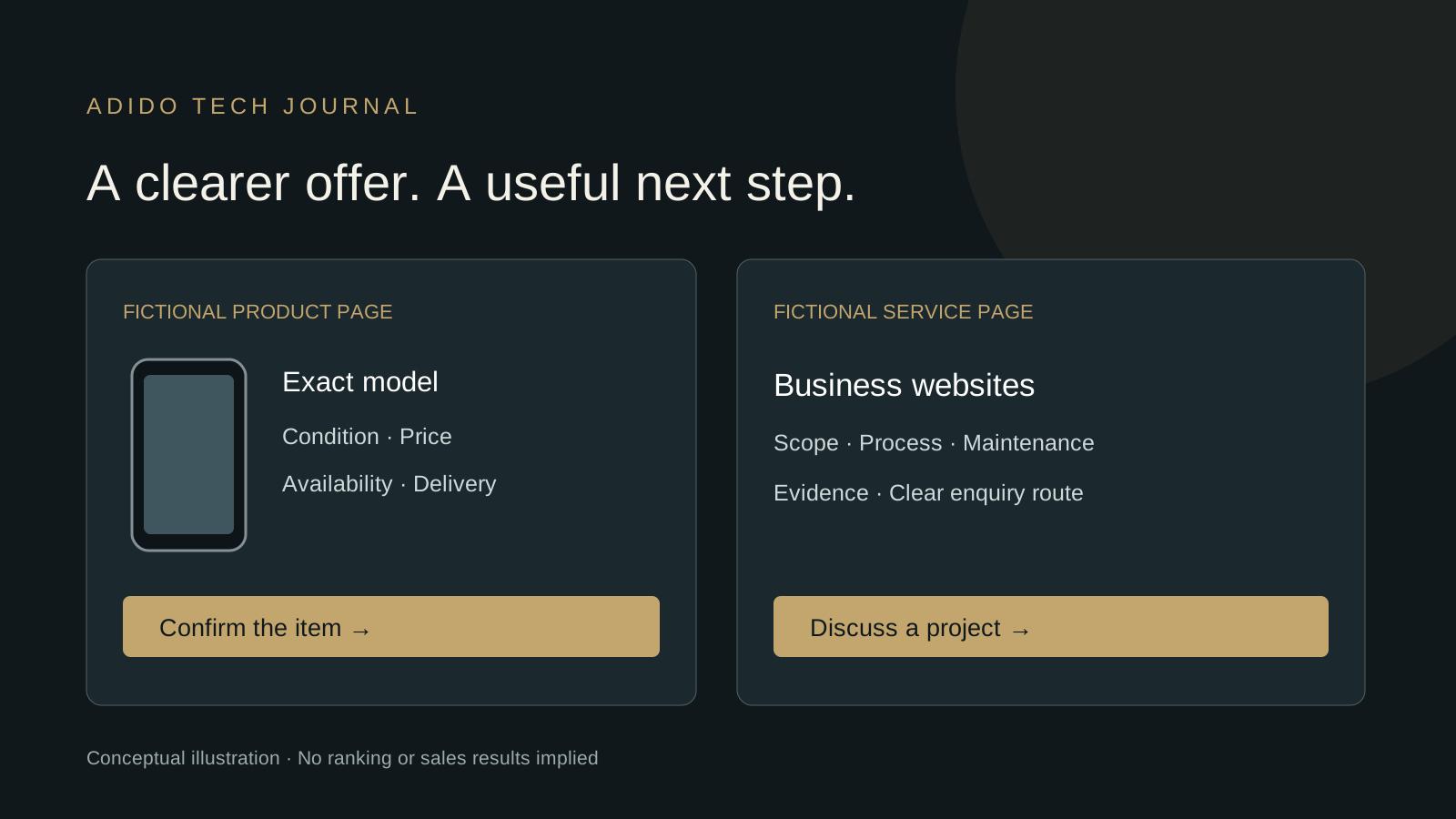
A customer asks Google where to buy a particular phone. Another asks who can build a website for a small business. Before either person contacts you, they need a clear answer: what do you offer, who is it for, and what should they do next?
AI-generated search answers make that question more visible. They do not remove the need for a useful business website. Your own pages are still where you can explain your offer, correct outdated information and give a visitor a reliable route to enquire or buy.
Improve the information a customer needs to make a decision. Make it accessible to search engines, keep it accurate and measure useful enquiries. No provider can promise that an AI answer will recommend your business.
What has changed in Google Search?
Google's documentation describes AI Overviews and AI Mode drawing on its search systems. Its optimization guide, updated 10 July 2026, still emphasizes useful content and a clear technical structure. It says special AI text files such as llms.txt are not needed for Google Search. [1]
Google also documents a Search generative AI inclusion control and a dedicated impressions report, with worldwide rollout dated 31 August 2026. Inclusion is the default for a top-level property; child properties can inherit a parent's choice. A report may be absent when there are too few impressions. [2] [3]
This is a practical guide to those documented features, not a claim that they launched this week. We reviewed public documentation on 30 October 2026; we did not test a client's rankings or results.
Two businesses, two pages that answer real questions
Consider these fictional examples. They illustrate an editorial checklist, not client case studies.
| A shop selling phones | A company building business websites |
|---|---|
| Identify the exact model, storage and condition. Distinguish a reference photograph from the actual item. | Explain the deliverable: a business website, product catalogue, online store or custom business system. |
| State a confirmed price and availability, or clearly say that both need confirmation. | Describe scope, process, maintenance and what the customer must supply. Mark indicative pricing as indicative. |
| Explain delivery or collection, warranty terms and the ordering route. | Show genuine work with permission, or label demonstrations as fictional. Offer a clear project-enquiry route. |
Neither page becomes stronger by repeating “best” or “AI optimized.” A customer needs specifics they can check. A service business should explain its work as carefully as a retailer describes a product.
A six-point website check
How clearly does your site explain your business?
Use this planning checklist. It is not an automated website scan or a prediction of search visibility.
0 of 6 checks marked. Your choices stay on this page only.
For an Accra retailer, the next step might be a WhatsApp enquiry confirming the exact item and collection arrangements. For a service firm working with Canadian or international customers, it may be a project form collecting requirements and the customer's preferred contact method. Choose the route your team can actually support.
Make the handoff explicit. A website enquiry is not a paid order. A stock figure should come from a maintained record. A quotation is not an issued invoice. If you later connect forms, sales records, e-signatures or invoicing, define who checks each transition and what happens when information is missing.
Measure business outcomes, with realistic expectations
Start a simple record of website changes and qualified enquiries. Ask what the visitor needed, which page helped and whether the team could fulfil the request. Obtain consent where appropriate and avoid sending names, telephone numbers or form contents to analytics tools.
Google's generative AI report describes impressions, including breakdowns by page, country and device. An impression means visibility; it does not establish a visit, sale or profit. Use it alongside your own operational records rather than claiming that a chart proves new revenue. [3]
Indexing, inclusion and recommendations are not guaranteed. Google's documentation does not establish how ChatGPT, Bing or other providers choose sources. Older Google guidance differs from the newer control and reporting pages, so check the current documentation and your actual Search Console interface before following a menu-by-menu tutorial. [1] [4]
For developers & IT professionalsExplore the Technical DetailsIndexing, page structure, accurate product data and useful measurement.
Audit the page a crawler and a customer receive
- Check the final URL, status code, canonical URL and indexing directives. Confirm that the intended public page is accessible without signing in.
- Inspect the rendered page. Verify that core offer details exist as text and that navigation reaches the page.
- Compare any structured data with the visible offer. Do not add invented reviews, unconfirmed stock or a price that the page contradicts.
- Review Search Console's inclusion control, including inherited settings. Keep access limited to authorized owners. [2]
- Test the enquiry or ordering route from a phone. Check validation, confirmation, duplicate submission handling and the team's follow-up process.
A fictional content brief before writing code
Page type: website-development service
Audience: small business owner
Offer: defined website scope and maintenance options
Evidence: clearly labelled demo or permitted real project
Next step: send a project enquiry
Owner: person responsible for keeping this page accurate
This is an editorial planning example, not a Google schema or a guaranteed ranking recipe. For a product page, replace the service fields with the precise item, truthful availability and ordering terms. Treat each offer as its own maintained record.
Separate discovery from conversion
Define events such as opening an enquiry form and receiving a valid enquiry separately. A click on WhatsApp does not prove a conversation or sale. Record only the minimum information needed, and test measurement in a controlled example before using it to assess business performance.
Versions and fixes: not applicable. This is a website-content and operations guide, not a vulnerability advisory. These checks are proposed implementation guidance; the Journal has not measured a resulting improvement in visibility or sales.
Choose one offer and make it clearer
You do not need to rewrite your entire website in one afternoon. Choose one product or service that matters to the business. Answer the customer's questions, assign someone to maintain the details, and make the next step work.
Adido Tech builds business websites, online catalogues and practical digital systems. Explore the services and clearly labelled demonstrations, or discuss a website or maintenance project. The right scope starts with the business problem you need to solve.
Sources, method and image credit
Documentation reviewed 30 October 2026. Examples are fictional; no client outcomes, product testing or savings are claimed.
- Google: Optimizing for generative AI features — updated 10 July 2026.
- Google: Search generative AI control — documents worldwide rollout on 31 August 2026; checked 30 October.
- Google: Generative AI performance report — documents worldwide rollout on 31 August 2026; checked 30 October.
- Google: AI features and your website — updated 10 December 2025; older guidance retained here to identify documentation differences.
Illustration: original conceptual artwork by Adido Tech Journal. The displayed page cards are fictional, not screenshots of a search result or a client website.
Was this article helpful?
Ask a question or suggest an improvement
Read next
CybersecurityA small compression component could expose your website. Here’s what to update.
The Brotli decoder vulnerability explained for website owners, with fixed versions and a practical maintenance checklist for developers.
Useful technology, clearly explained.
Request email updates from Adido Tech Journal. We plan two useful articles each week.
Email delivery is being prepared. You can follow the RSS feed now.