
Your shop opens its website in the morning and everything looks normal. Customers can still browse. Yet a software component deep inside a server may need an urgent update. Security maintenance is often about the parts a visitor never sees.
The component in this case is Brotli, a widely used compression library. The immediate task for a business owner is to ask the maintainer which deployed applications use a vulnerable decoder and when they will be updated.
Send your website or IT maintainer the identifier CVE-2026-111497. Ask for an inventory, an exposure assessment and an update plan. A working homepage is not evidence that the underlying software is patched.
What happened?
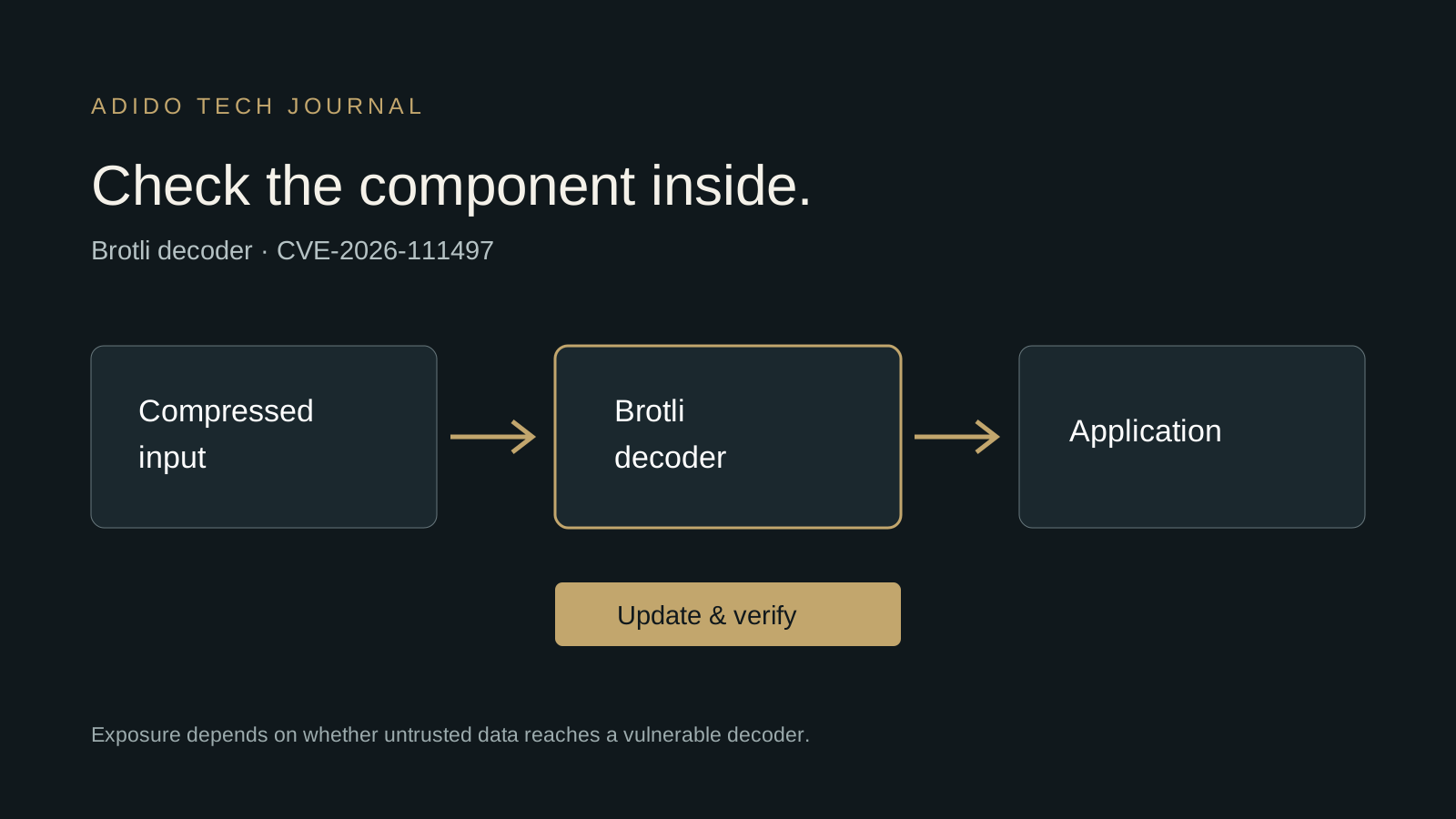
Google's upstream Brotli 1.2.1 release, dated 21 October, identifies a decoder out-of-bounds write that can permit remote code execution. [1] A decoder turns compressed data back into information an application can use.
Canada's Cyber Centre issued its alert on 28 October. It reports that CISA added this CVE to the Known Exploited Vulnerabilities catalogue on 27 October. This is a report of exploitation beyond a laboratory proof of concept, not evidence that every affected installation has been attacked. [2]
The Node.js project describes malformed Brotli input corrupting process memory through the bundled decoder. Possible outcomes include a crash, exposure of process memory or code execution when an attacker can supply data the application decompresses. Node rates its issue High; the Canadian alert describes the broader vulnerability as Critical. [3]
Who needs to check?
Start with the team responsible for websites, servers, business applications and packaged software. The Cyber Centre names multiple technologies that can bundle Brotli, including Node.js, .NET, PowerShell, Bun, Envoy, Istio and Python packages. Each product needs its own vendor guidance; the name alone does not establish an exploitable deployment. [2]
For a shop or service firm in Ghana, Canada or elsewhere, the useful distinction is ownership. Your own developers can examine applications they operate. A managed hosting or software provider must confirm the components it operates. A visitor should not be told to replace a library inside a service they do not control.
Affected and fixed versions
The Cyber Centre lists these upstream library ranges. Versions in a different package or distribution may use vendor backports; check that vendor's advisory rather than judging only by a displayed version string. [2]
| Affected versions | Fixed release |
|---|---|
| 1.0.3 up to, but not including, 1.0.10 | 1.0.10 |
| 1.1.0 up to, but not including, 1.1.1 | 1.1.1 |
| 1.2.0 up to, but not including, 1.2.1 | 1.2.1 |
Node.js's 21 October security bulletin identifies its 22.x, 24.x and 26.x branches and supplies the following security releases. Use an appropriate supported release containing these fixes or a later vendor-supported update. This table is not a promise that other branches are safe. [3]
| Branch | Security release |
|---|---|
| 22.x | 22.23.4 |
| 24.x | 24.22.1 |
| 26.x | 26.12.1 |
A practical maintenance request
Ask your maintainer for a short written response covering these four points:
- Inventory: which running applications, containers and third-party services may contain the affected component?
- Exposure: can untrusted compressed input reach a vulnerable decoder, and which vendor advisory supports the assessment?
- Remediation: what will be updated, rebuilt, restarted or redeployed, and when?
- Verification: what evidence shows the running service contains the fixed component, and which customer functions were checked afterwards?
Agree who owns the work. For a busy business, a maintenance task without an owner and a completion check can remain unfinished even after an update has been downloaded.
The Cyber Centre recommends preventing affected applications from processing untrusted Brotli-compressed content until an update can be applied. [2] Whether that is feasible depends on the application. Treat it as temporary containment, with an explicit plan to update.
Turning off compression for the pages your server sends out does not, by itself, establish that it has stopped decompressing incoming or downloaded data. Ask the maintainer to identify the actual decoder path. This is an engineering implication of the affected operation, not a claim that the Journal tested your server.
What we know—and what we do not
The linked advisories establish the flaw and released fixes. They do not establish whether your particular site is reachable through the vulnerable path or whether it has been compromised. That requires your maintainer's deployment review and, where appropriate, investigation of relevant logs.
This article is based on primary documentation checked on 30 October 2026. We did not reproduce an exploit, scan readers' systems or test a client deployment. Unexpected crashes should be investigated, but a crash alone does not prove exploitation.
For developers & IT professionalsExplore the Technical DetailsInventory the running runtime, trace decoder reachability and verify the deployment.
Inspect the runtime that actually runs the application
The Node.js process API exposes runtime and dependency version information. This read-only command prints the Node.js version and its reported Brotli dependency version. Run it inside the relevant application environment, not only on your development laptop. [4]
node -p 'JSON.stringify({node:process.version,brotli:process.versions.brotli},null,2)'This is an inventory command, not an exploit test or a vulnerability scanner. A separately bundled native module, service or container may contain another copy. An undefined dependency field is not evidence of safety.
Trace reachability before declaring exposure
Map the trust boundary: where does compressed content originate, which code decodes it, and under which runtime? Review direct uses of node:zlib as well as libraries that perform decompression on the application's behalf. The Node bulletin describes a streaming-decoder buffer error; a dependency name in a manifest alone does not show whether that code path is reachable. [3]
Close the deployment loop
- Record the running artifact and its vendor advisory.
- Apply a supported fix using the vendor's installation process.
- Rebuild artifacts that embed old components and redeploy all relevant instances.
- Check the runtime inside the new deployment and record the evidence.
- Verify representative business flows—such as browsing, enquiry submission or checkout—in an appropriate test environment.
This workflow is proposed defensive implementation guidance. The Journal has not run these checks against your application. Vendor-specific backports and managed services need written confirmation from the provider.
Make software maintenance a business habit
Keep a simple list of the systems your business depends on, their maintainers and their support status. Updates become easier to coordinate when someone can answer those questions before an urgent advisory arrives.
For help defining website maintenance or reviewing the software behind an online store or business system, contact Adido Tech about the scope. An enquiry does not replace the immediate update work your current provider may need to perform.
Primary sources and editorial method
- Google Brotli: release 1.2.1 — 21 October 2026.
- Canadian Centre for Cyber Security: AL26-027 — 28 October 2026. Source for the library ranges and reported 27 October CISA KEV addition.
- Node.js: October security releases — 21 October 2026.
- Node.js process.versions documentation — living documentation checked 30 October 2026.
Original conceptual illustration: Adido Tech Journal. It describes the affected data path; it is not a screenshot of an attack. Guidance may change as vendors publish additional updates. Last checked: 30 October 2026.
Was this article helpful?
Ask a question or suggest an improvement
Read next
Digital BusinessCan customers find your business through AI search? Start with your website.
A practical guide for shops and service firms: clearer offers, accurate product information and a website that helps customers take the next step.
Useful technology, clearly explained.
Request email updates from Adido Tech Journal. We plan two useful articles each week.
Email delivery is being prepared. You can follow the RSS feed now.